
More than ever, leaders are recognizing that creating a diverse, equitable, and inclusive workplace is critical to their organization’s long-term success. After all, companies with greater diversity in their staff and management teams out-perform those that don’t, achieve higher levels of profitability, and are more likely to have superior value creation (McKinsey). But success goes well beyond recruiting a diverse workforce. How do you retain diversity?
As EdSurge points out in their article on diversity hiring, “diversity, equity and inclusion aren’t short-term projects. Instead, they’re constant processes of improvement and self-reflection…if you’re starting to look at diversity only when you need to fill a position, you’ll find it very hard to achieve.” Instead:
Begin with a deep organizational assessment.
Before your organization can successfully recruit and retain a diverse candidate pool, it needs to honestly and accurately identify whether diversity is core to its mission, values, and programs. Consider these questions: What is the current status and success of your organization’s diversity, equity, and inclusion efforts? Are your leadership and staff diverse? Do the values of DEI inform your external and internal programming? Why or why not? Only by taking the time to assess the current status of your organization’s efforts can you clearly understand the strengths and potential challenges you will encounter – and honestly communicate this to candidates. Furthermore, if your assessment reveals opportunities to improve your organization’s efforts, this is the time to outline and pursue the steps necessary to create a true culture of inclusion. Which leads to our next point…
Without an inclusive culture, it will be difficult to recruit a diverse workforce and impossible to retain.
Your organization’s stakeholders must be invested in and committed to the success of all staff, so they feel supported, valued, and heard.
“Organizations should be inclusive in their practices on the ground,” Lori Smith Britton, Founder and Principal, Community Resource Consulting, says. “There should be an openness to discussing issues of race, class, and equity in a healthy way. These are topics nonprofits need to be able to grapple with in order to achieve inclusion.”
“Retention is impacted by how we interact with each other. It’s important to have an asset-based approach to colleagues as opposed to making assumptions about what they don’t know or can’t do. Recognize their unique skillset and the value they add. Moreover, it’s important for everyone to take responsibility for their own learning on these issues and not expect staff that represent a particular group to speak on behalf of everyone who belongs to that group. It’s the entire organization’s responsibility to be culturally proficient and actively deconstruct biases.”
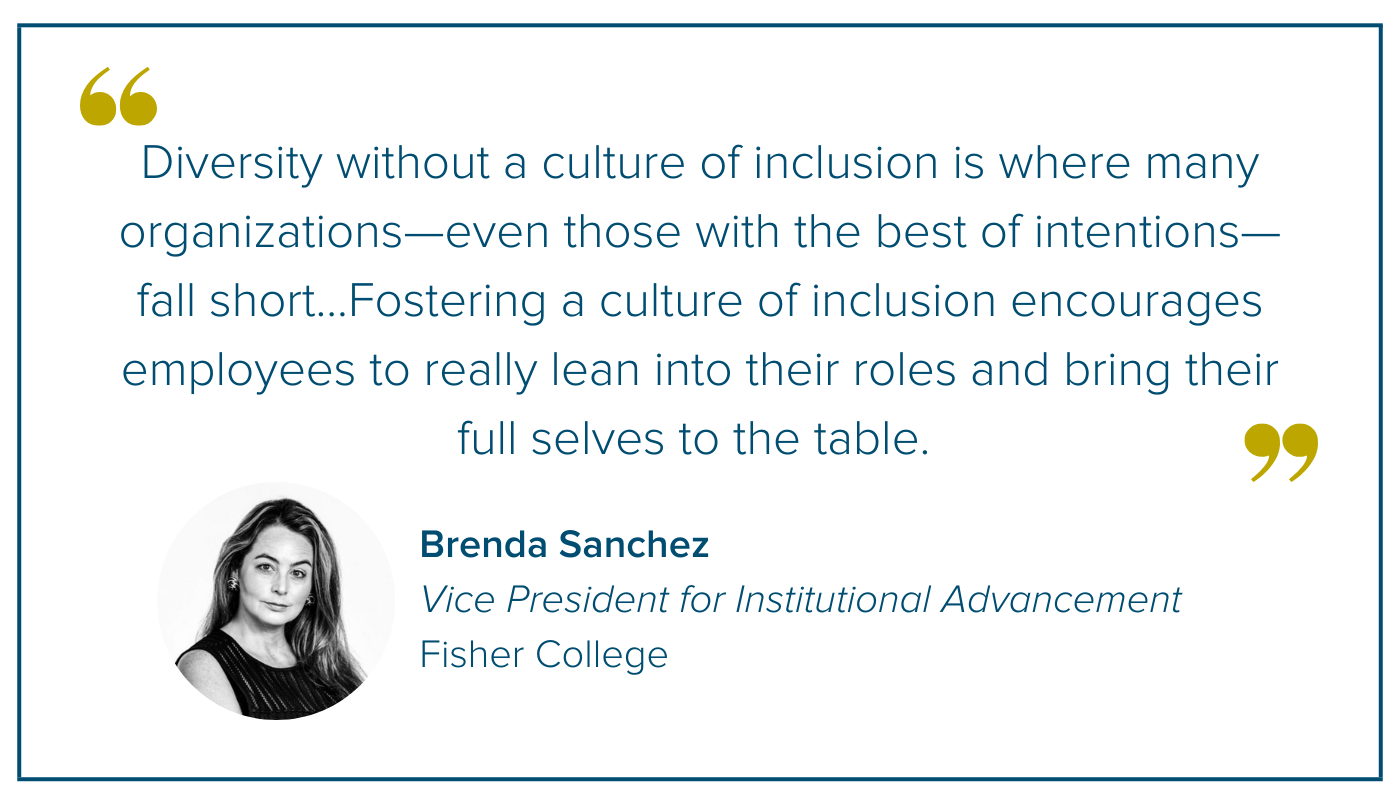
Brenda Sanchez, Vice President, Advancement & Alumni Engagement at Fisher College, adds, “Diversity without a culture of inclusion is where many organizations—even those with the best of intentions—fall short. [Organizations and leaders need to] understand the many dimensions of diversity. It’s not just about color and gender. Fostering a culture of inclusion encourages employees to really lean into their roles and bring their full selves to the table.” After all, employees are happiest when they’re able to be their authentic selves at work (Accenture).
Only once you’ve truly evaluated and strengthened your organization’s diversity, equity, and inclusion efforts should you turn your attentions to the recruitment process. When you do, keep the following in mind:
Developing the right candidate criteria is key.
To attract a diverse pool of candidates, especially when recruiting for a position within a field lacking in diversity (like Advancement!), re-thinking your candidate criteria is an excellent way to expand the pool. Include in your criteria only skills that are important to the core of the role. Candidates who possess transferrable skills may be successful in the position even if they do not have direct experience in the desired field. For instance, a university may consider candidates who come from the for-profit world for a fundraising position if the candidates are proven collaborators, strong public speakers, and/or effective spokespeople. Furthermore, EdSurge warns against placing too much stock in degrees from exclusive universities or former positions at highly-branded organizations: “[These] may look impressive, but focusing on these aspects may confuse a candidate’s background of privilege with their actual skills and result in a homogenous group of candidates.”
Also, keep in mind if you’re having difficulty creating a diverse candidate pool, don’t blame the field. Rather, reexamine your process. EdSurge explains, “People are attracted to the concept that ‘there’s a shortage, it’s not my fault’ versus ‘wow, there are some biases in my organization that are serving as barriers.’ It’s a very hard thing to unpack.” Smith Britton emphasizes, “We need to demystify the idea that it’s so hard to find and recruit staff who are not like us. We need to recognize and acknowledge that there are people who are not like us who are equally capable of getting the work done.” 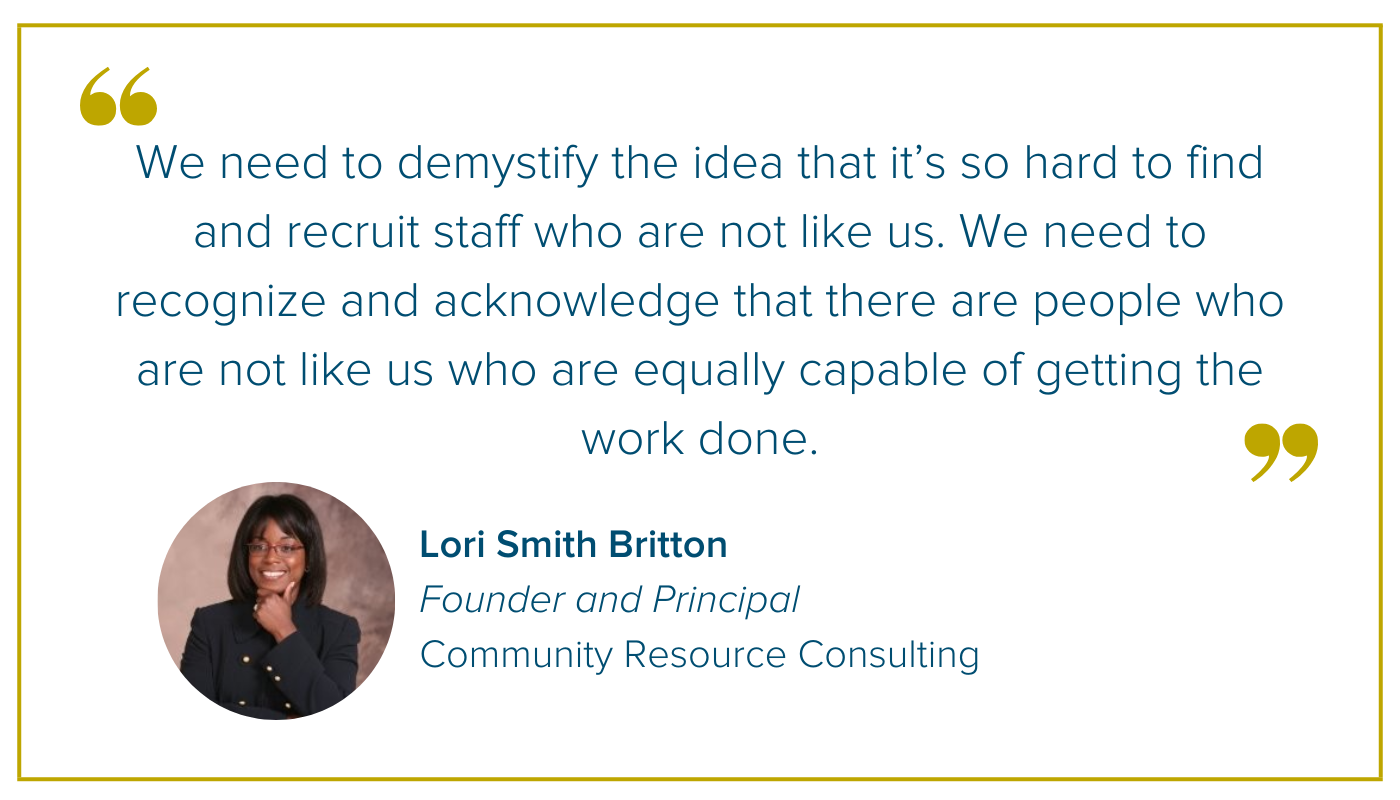
So, while identifying qualified candidates outside your regular network/sector may initially require more time than considering only those already in the field, it is well worth the effort! And remember, any time you can expand your candidate pool, you increase the probability of an excellent hire.
The recruitment process must feel respectful, inclusive, and appropriate.
Interviewers should keep in mind that it’s not just their responsibility to assess the qualifications and fit of candidates, but also to help candidates see that they would be respected and successful should they join the organization. EdSurge encourages “looking at who’s included in the decision-making process and make sure they are reflective of the candidate pool you want.” Consider, too: are there key leadership on staff who can speak to diversity, equity, and inclusion as a priority? What tangible information—such as metrics or internal initiatives—can you share with candidates to display this commitment?
Sanchez also recommends organizations seek out diversity-focused associations to better focus their outreach and promotional efforts for the position: “There are a number of multi-cultural professional associations out there that are eager to partner [with organizations committed to diversity hiring]. As someone in higher education at a college where 71% of the student population affiliates with a minority group, I think companies can do so much more to partner with schools that serve predominately minority populations.” Smith Britton adds, “Organizations can’t expect to be successful with a diversity-focused recruitment process if they only pursue the traditional channels. You need to ask yourself, ‘Where do the people that represent diversity exist and how can we reach them?’ Our network typically looks like we do, so it’s important to actively reach beyond that network.”
Lastly, be sure to keep your staff and community apprised of the search process, as appropriate; it’s a critical component of building consensus and buy-in. “Excellence exists in every community, culture, across gender, sexual orientation, etc. The message from leadership needs to be clear: diversity and excellence are not mutually exclusive values,” Smith Britton says. “Communicate to staff that we can achieve diversity and excellence because both exist.”